
The Medici Family between history and fiction
Medici Masters of Florence is a TV series on Netflix about the intrigues and tragedies of this powerful family of wealthy Florentine bankers who were the patrons of the most important Renaissance artists such as Botticelli, Leonardo da Vinci, and Michelangelo.
Who were the Medici?
The Medici were the most important family from Florence during the Renaissance, and they were the wealthiest bankers in Europe. They started from humble origins, but with Giovanni de’ Medici in the 15th century they became the rulers of the city and the main sponsors of art and culture thanks to the patronage of Lorenzo the Magnificent. He was more than just a diplomat; he was also a talented poet, one of his most famous verses is a reflection on the brevity of life and an invitation to live the moment and enjoy life. “youth is sweet and well/but doth speed away/let who will be gay/tomorrow none can tell”
They have dominated the political life of Florence and Tuscany for over 300 years, until the family died out in 1743.
The Medici made their money starting first as merchants in the textile industry, trading in wool and silk, then expanding their activity in banking with the opening of branch offices of their bank in the main cities of Italy and Europe: Milan, Venice, Lyon, London, Bruges, and finally becoming the chief bankers for the Roman Catholic Church.
In the meanwhile, they have always occupied important positions, first in the local government of Florence and then becoming Grand Dukes of Florence and Tuscany until the 18th century.
Three Popes and two Queens in the Medici Family
The Medici played a very important political role also outside Florence and Tuscany, because in the 16th century three members of the family were elected Popes: Pope Leo X, Pope Clement VII, and Pope Leo XI. The first Medici Pope, Leo X, was one of the sons of Lorenzo the Magnificent; born Giovanni de’ Medici, he was raised in Italy’s most sophisticated city, Florence, and he became one of the most extravagant Popes, more a patron of the arts, as his parents were, than a significant ecclesiastical figure. He encouraged the sale of “indulgences” to get significant sums of money for the renovation of Rome. This practice aroused the ire of Martin Luther who issued 95 arguments for the reformation of the church.
In the same century two women of this family became queens of France: Catherine de Medici, who married Henry II and Mary de Medici, who became the wife of Henry IV.
When Catherine married King Henry II of France in 1533, she brought from Italy a taste for entertainments in which dance was prominent, establishing the court ballet. She introduced to France a long list of food from Florence and the “forks,” unknown in France until then. She introduced to the French court the use of fragrances thanks to her chief perfumer, Renato Bianco. “René le Florentin,” as he was known in France, made a strong contribution to the birth of many French perfumers to provide fragrances for the aristocrats of the city.
The Pazzi Conspiracy
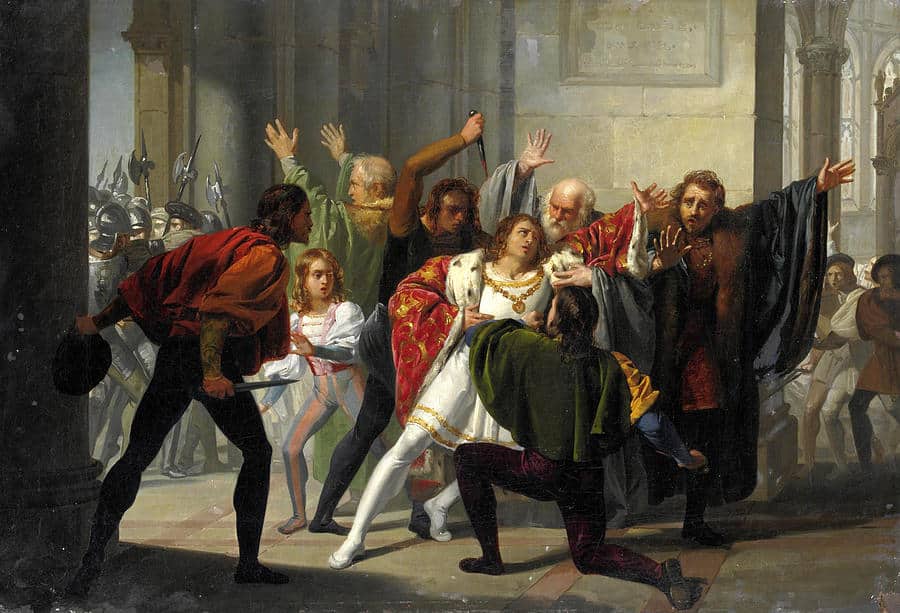
The first bloody event in the Medici Family is the Pazzi Conspiracy which took place in Florence on the 26th of April, 1478 when the Pazzi Family, bankers in competition with the Medici decided to kill Lorenzo and Giuliano de Medici; however, only Giuliano, Lorenzo’s younger brother, died. He was stabbed 19 times inside the Cathedral of Santa Maria del Fiore during the High Mass in front of the main altar. Lorenzo was wounded but survived. The failure of the plot strengthened the political position of the Medci, and the revenge of Lorenzo the Magnificent was terrible, and many of the conspirators were killed.
The assassination of Alessandro, first Duke of Florence
In 1537 Alessandro the Medici, illegitimate son of Giulio de Medici (Pope Clemens the VII) was declared the first Duke of Florence, but he was loved neither by the people nor by the rest of his family because he was an arrogant despot. One night his cousin Lorenzino, attracted him in his house with the promise of a night with a mysterious woman and in the darkness he murdered him.
Isabella and Leonora
Isabella and Leonora were sisters-in-law; they were beautiful, intelligent, and well-educated but were married to two very violent men, Paolo Orsini and Pietro Medici. In mid-July 1576 the two ladies were found death in their Villas, both strangled. It is said that their ghosts are still around at night in the Villa Cerreto Guidi and Villa Cafaggiolo.
The death of two young Medici brothers
Giovanni and Garcia de’ Medici are the sons of Cosimo the Medici. first Grand Duke of Tuscany and his wife, Leonora of Toledo. In 1562 they were in Pisa and while hunting Giovanni was killed by accident by his brother. When Cosimo the father found out what had happened, he was so overwhelmed by anger that killed his son Garcia with his hands.
Leonora, the mother of the two children, could not stand these tragic deaths and died of heartbreak.
The three bodies were brought back to Florence in secret and buried very quickly without funerals and ceremonies as their role would have required and the official cause of their deaths was malaria.
The poisoning of Francesco and Bianca
Francesco de Medici, son of Cosimo, was the second Grand Duke of Tuscany and Bianca Cappello was his second wife , married after the death of the Grandduchess Joan of Austria.
In 1587, Francesco and his wife Bianca where in their Villa di Poggio a Caiano near Florence together with Ferdinando, when both started to feel sick after dinner and then died in few days.
Because Francesco didn’t have sons, Ferdinando decided to leave Rome and his role in the church becoming the third Grand Duke of Tuscany.
Even in this case, however, the truth has been hidden for many centuries, and the official version was, once again, death from malaria….
If you want to know more and enjoy a private tour in Florence, please click here